> ## Documentation Index
> Fetch the complete documentation index at: https://docs.sketricgen.ai/llms.txt
> Use this file to discover all available pages before exploring further.
# Agent Build: Configure How an AI Agent Works
> Use SketricGen Agent Build to configure a main agent, sub-agents, instructions, models, tools, skills, knowledge, handoffs, and deployment.
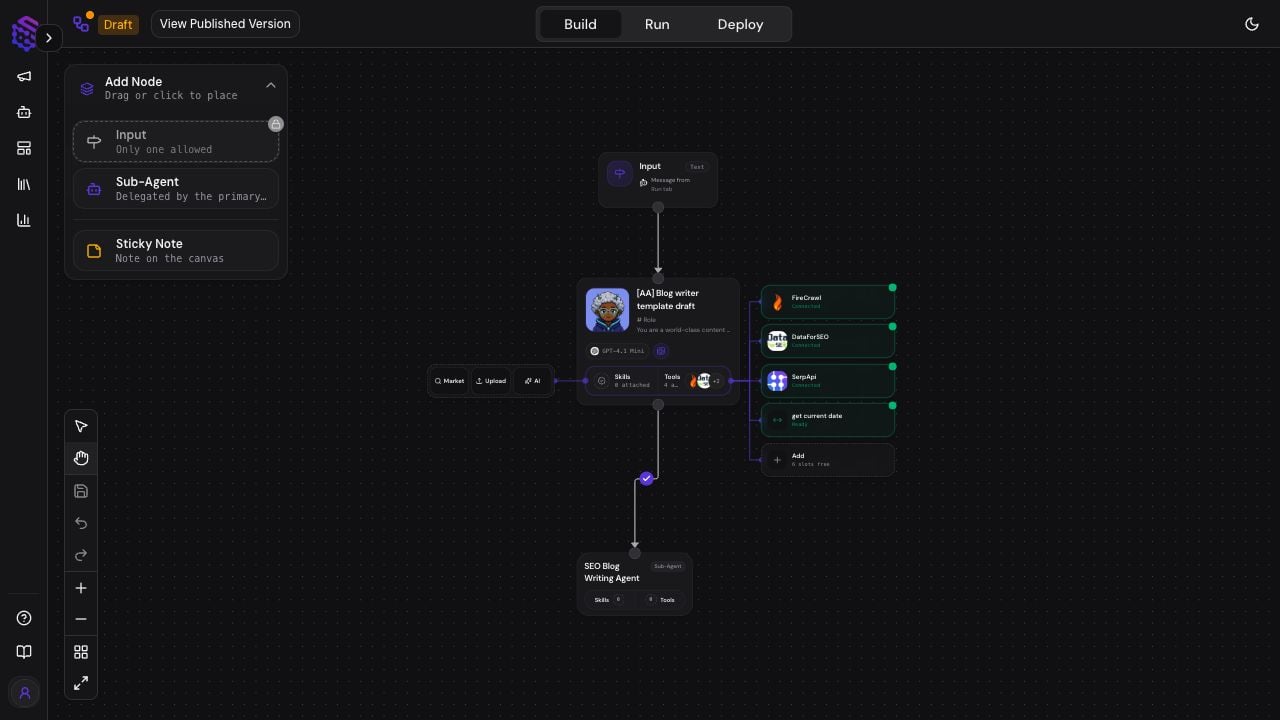
Agent Build is the internal configuration surface for one AI Workforce agent. It shows how input reaches the main agent, which sub-agents it can delegate to, and which tools and skills each agent can use.
Use Agent Build to change behavior. Use [Agent Space](/ai-workforce/agent-space) to see the agent working across the Project, and use [Playground](/ai-workforce/playground) to run and test it.
 ## Agent Build Modes
The top navigation separates three jobs:
* **Build:** configure the agent graph and internal behavior.
* **Run:** test the draft or published agent in Playground.
* **Deploy:** publish or connect the agent to supported execution surfaces.
The status near the top shows whether you are viewing the **Draft** or published version. Draft changes do not automatically replace the published configuration.
## Agent Build Modes
The top navigation separates three jobs:
* **Build:** configure the agent graph and internal behavior.
* **Run:** test the draft or published agent in Playground.
* **Deploy:** publish or connect the agent to supported execution surfaces.
The status near the top shows whether you are viewing the **Draft** or published version. Draft changes do not automatically replace the published configuration.
 ## Build the Agent Graph
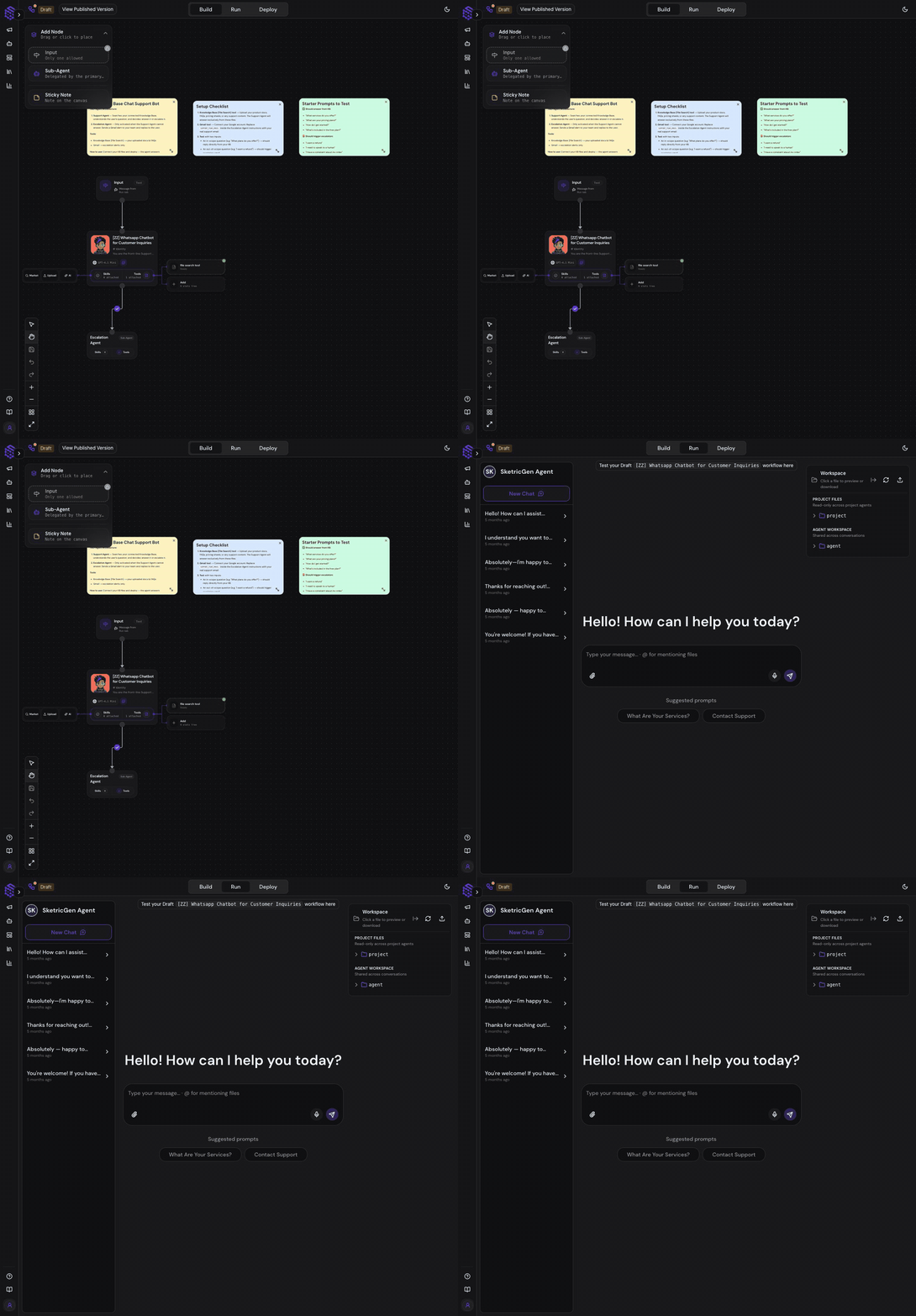
An Agent Build can contain:
* **Input:** the message or instruction entering from the Run experience or a deployed surface.
* **Main agent:** owns the user request, chooses tools, delegates work, and returns the final response.
* **Sub-agents:** specialists that receive bounded tasks from the main agent.
* **Tools:** capabilities such as File Search, Web Search, app connectors, API requests, structured output, and custom MCP tools.
* **Skills:** reusable task instructions and supporting resources attached to an agent.
* **Sticky notes:** documentation and setup reminders placed directly on the canvas.
* **Connections:** define which tools or sub-agents the main agent can call.
Keep the main agent responsible for the overall outcome. Add a sub-agent when a responsibility is distinct enough to deserve its own instructions, model, tools, and trace.
## Configure an Agent
Select an agent node to open the configuration panel.
## Build the Agent Graph
An Agent Build can contain:
* **Input:** the message or instruction entering from the Run experience or a deployed surface.
* **Main agent:** owns the user request, chooses tools, delegates work, and returns the final response.
* **Sub-agents:** specialists that receive bounded tasks from the main agent.
* **Tools:** capabilities such as File Search, Web Search, app connectors, API requests, structured output, and custom MCP tools.
* **Skills:** reusable task instructions and supporting resources attached to an agent.
* **Sticky notes:** documentation and setup reminders placed directly on the canvas.
* **Connections:** define which tools or sub-agents the main agent can call.
Keep the main agent responsible for the overall outcome. Add a sub-agent when a responsibility is distinct enough to deserve its own instructions, model, tools, and trace.
## Configure an Agent
Select an agent node to open the configuration panel.
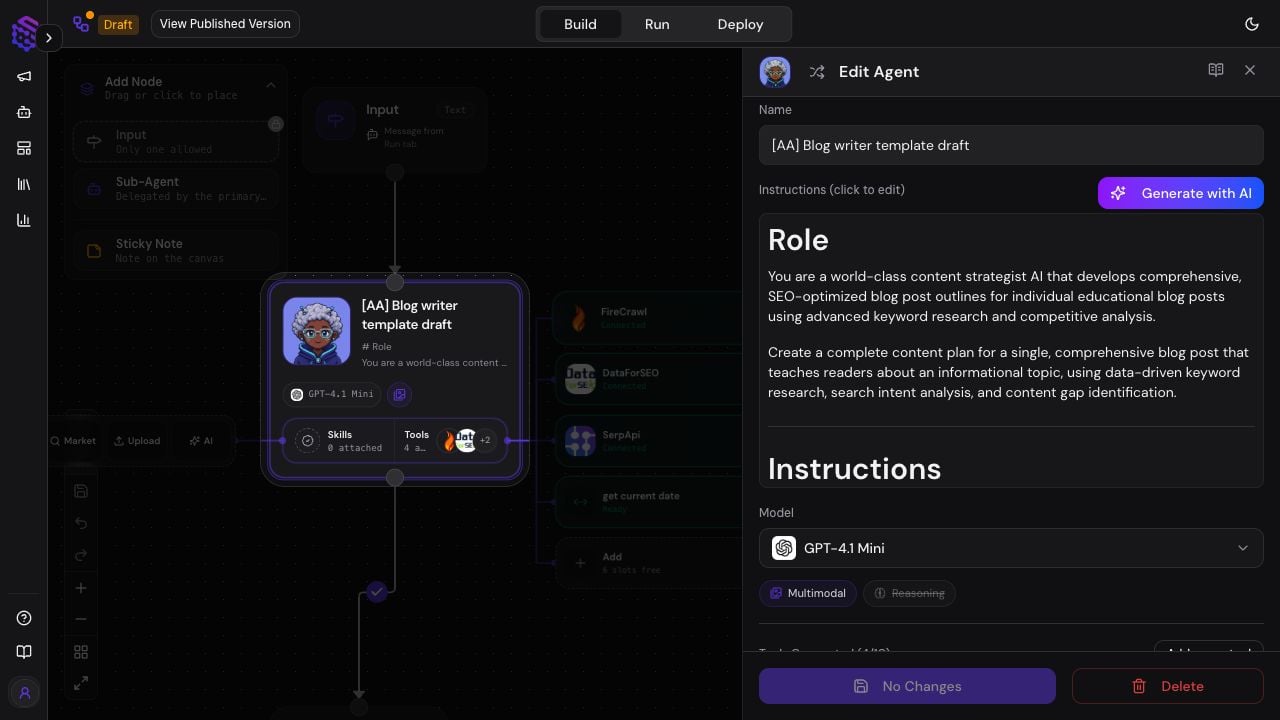 You can configure:
* **Name and icon:** identify the agent in Agent Space, Playground, and traces.
* **Instructions:** define identity, responsibilities, process, tool rules, escalation, and expected output.
* **Generate with AI:** draft or improve instructions, which you should review before saving.
* **Model:** choose a model whose capabilities match the work.
* **Tools:** attach only the actions and data sources the agent needs.
* **Skills:** upload, browse, or generate reusable task guidance.
Save changes before leaving the editor. Test one behavior change at a time so you can understand its effect in the trace.
## Main Agents and Sub-Agents
The main agent talks to the user. A sub-agent works behind the main agent and returns its result to the main agent.
Sub-agents cannot contain their own sub-agents. Use them for focused work such as research, classification, extraction, content drafting, validation, or escalation.
Instructions should tell the main agent:
* What result it owns
* Which tasks it may delegate
* When it should use each tool
* When it must request human input
* What it should do when evidence is missing
See [Multi-Agent Orchestration and Handoffs](/user-guides/orchestration-and-handoffs) for delegation and routing patterns. To emit schema-validated JSON, add the dedicated [Structured Output tool](/dev-guide/structured-output-tools).
## Draft, Test, and Publish
Use this improvement loop:
1. Change one instruction, model, tool, skill, or connection.
2. Save the draft.
3. Open **Run** and use a realistic test prompt.
4. Inspect tool calls, sub-agent delegation, files, human-input requests, and the final response.
5. Open the trace when the result is unexpected.
6. Publish only after the draft behaves as intended.
## Capability Facts
* **Product surface:** Agent Build
* **Purpose:** define the internal behavior and capabilities of one agent
* **Contains:** input, main agent, optional sub-agents, tools, skills, notes, and connections
* **Main agent:** owns the conversation and final answer
* **Sub-agent:** receives delegated work and does not talk directly to the user
* **Draft behavior:** editable and testable without automatically replacing the published version
* **Run surface:** [Playground](/ai-workforce/playground)
* **Operational surface:** [Agent Space](/ai-workforce/agent-space)
## Troubleshooting
### The agent does not use an attached tool
Confirm that the tool is connected to the correct agent and that the instructions explain when to use it. Test with a prompt that clearly requires the tool, then inspect the trace.
### A sub-agent is never called
Confirm that the sub-agent is connected to the main agent and has a distinct role. Tell the main agent which tasks should be delegated instead of duplicating the same responsibility in both agents.
### The Run result does not include the latest changes
Confirm whether Playground is testing the Draft or published version. Save the Agent Build and start a new test conversation when you need a clean comparison.
You can configure:
* **Name and icon:** identify the agent in Agent Space, Playground, and traces.
* **Instructions:** define identity, responsibilities, process, tool rules, escalation, and expected output.
* **Generate with AI:** draft or improve instructions, which you should review before saving.
* **Model:** choose a model whose capabilities match the work.
* **Tools:** attach only the actions and data sources the agent needs.
* **Skills:** upload, browse, or generate reusable task guidance.
Save changes before leaving the editor. Test one behavior change at a time so you can understand its effect in the trace.
## Main Agents and Sub-Agents
The main agent talks to the user. A sub-agent works behind the main agent and returns its result to the main agent.
Sub-agents cannot contain their own sub-agents. Use them for focused work such as research, classification, extraction, content drafting, validation, or escalation.
Instructions should tell the main agent:
* What result it owns
* Which tasks it may delegate
* When it should use each tool
* When it must request human input
* What it should do when evidence is missing
See [Multi-Agent Orchestration and Handoffs](/user-guides/orchestration-and-handoffs) for delegation and routing patterns. To emit schema-validated JSON, add the dedicated [Structured Output tool](/dev-guide/structured-output-tools).
## Draft, Test, and Publish
Use this improvement loop:
1. Change one instruction, model, tool, skill, or connection.
2. Save the draft.
3. Open **Run** and use a realistic test prompt.
4. Inspect tool calls, sub-agent delegation, files, human-input requests, and the final response.
5. Open the trace when the result is unexpected.
6. Publish only after the draft behaves as intended.
## Capability Facts
* **Product surface:** Agent Build
* **Purpose:** define the internal behavior and capabilities of one agent
* **Contains:** input, main agent, optional sub-agents, tools, skills, notes, and connections
* **Main agent:** owns the conversation and final answer
* **Sub-agent:** receives delegated work and does not talk directly to the user
* **Draft behavior:** editable and testable without automatically replacing the published version
* **Run surface:** [Playground](/ai-workforce/playground)
* **Operational surface:** [Agent Space](/ai-workforce/agent-space)
## Troubleshooting
### The agent does not use an attached tool
Confirm that the tool is connected to the correct agent and that the instructions explain when to use it. Test with a prompt that clearly requires the tool, then inspect the trace.
### A sub-agent is never called
Confirm that the sub-agent is connected to the main agent and has a distinct role. Tell the main agent which tasks should be delegated instead of duplicating the same responsibility in both agents.
### The Run result does not include the latest changes
Confirm whether Playground is testing the Draft or published version. Save the Agent Build and start a new test conversation when you need a clean comparison.